If you want to know whether Euronat is the right place for you, you’ll find an honest answer here. Written from an insider’s perspective: we’ve been renting out three holiday homes in the Afrique village for years, and we know the site from buying croissants in the morning to watching the sun set over the Atlantic.
What is Euronat?
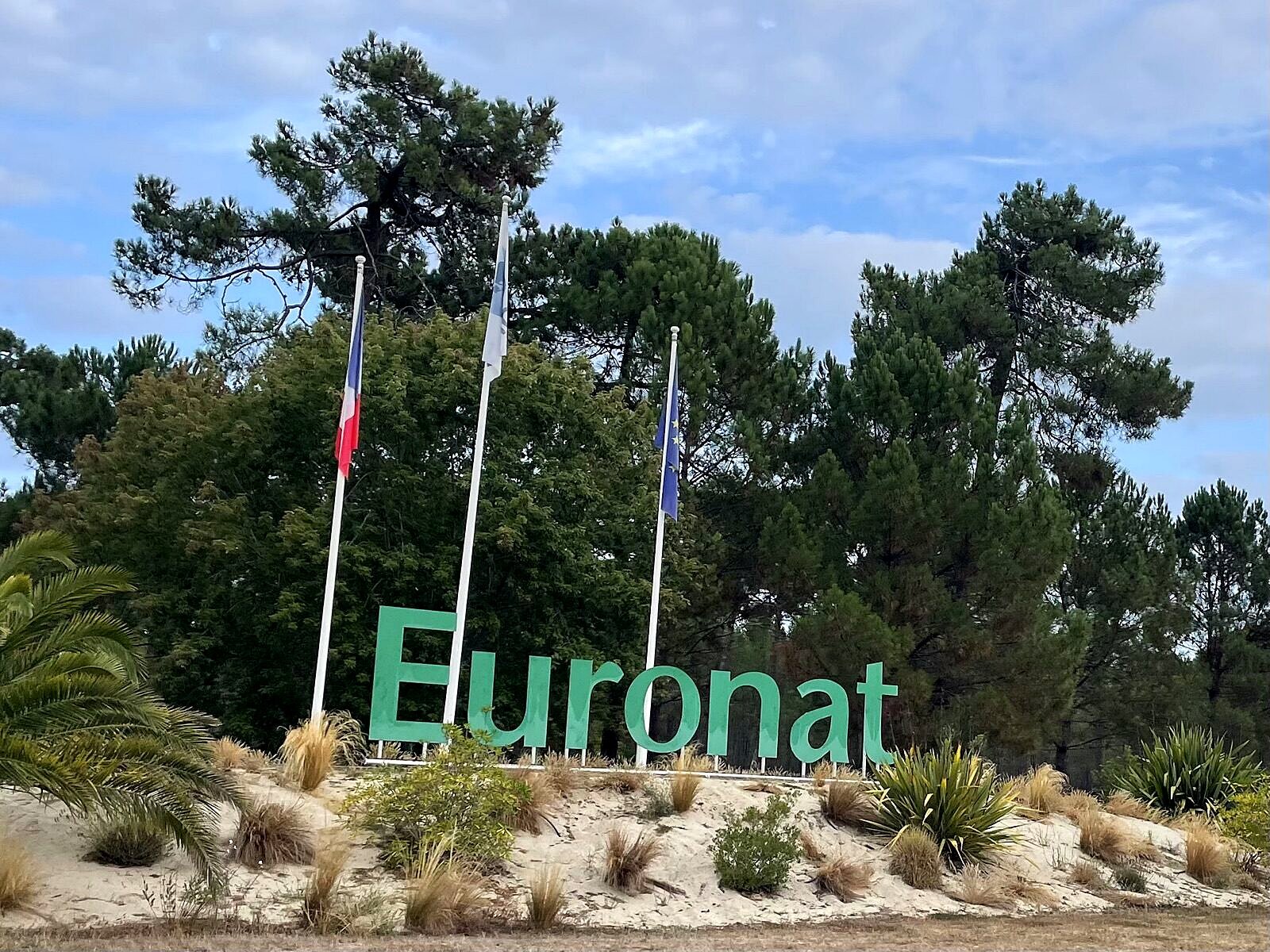
Euronat is officially a naturist campsite — and at the same time much more than that.
That’s the first thing we explain to people who want to come by for the first time. When you hear the word “campsite”, you think of a barrier, a meadow, perhaps a few sanitary buildings. Euronat is something else. It’s a 335-hectare pine forest on the Atlantic coast in Grayan-et-l'Hôpital, with its own 1.5 km beach, a swimming pool, a thalasso centre, a village square with more than twenty shops and restaurants, and a 2.5 km central avenue that ties it all together. This is more a small village than a campsite — with its own bakery in the morning, its own market, its own infrastructure.
At the same time, it’s true: the heart of Euronat is and remains the campsite. Around 1,400 pitches for tents, caravans and motorhomes lie scattered through the pine forest. Add to that mobile homes, chalets, studios, villas — and private houses like our three. Whoever comes with a caravan is just as at home here as someone renting a fixed house. The mix is part of the character: it isn’t one or the other.
Euronat was founded in 1975 by Hubert Lacroix, a French visionary who took the idea of Club Méditerranée and translated it into naturism. Today his family runs the resort in the third generation — and you can feel it, even after 50 years. There’s a continuity that shows in the habits of the regulars, in the tone of the staff, in how the grounds are maintained. Many have been coming here for decades. Some grew up at Euronat and now come back with their own children.
What sets Euronat apart from a pure campsite is this combination of size, infrastructure and atmosphere. What defines it, is the matter-of-factness with which life has been lived here for five decades.
Naturism explained
What naturism means at Euronat
At Euronat, naturism means: clothes-free wherever possible, with respect and as a matter of course. On the beach, at the pool, in front of your own cabin, when fetching your bread in the morning. No-one stares, no-one judges, no-one comments. This isn’t “just so” — it’s a practised way of being together that has been cultivated here since 1975, and that defines the character of the place.
Most first-time visitors need about half a day until their shoulders come down. You walk to the bakery, you see other people buying bread, chatting, playing with their children — and after a short while you realise that no-one is actually looking. That’s the moment when many people understand, for the first time, what “natural” actually means.
What beginners need to bring
Not much. A towel to sit on — that’s standard naturist etiquette: wherever you sit down, your own towel goes underneath. Sunscreen, because the Atlantic isn’t gentle. And openness. That’s it.
What you don’t need: a camera. Photography is taboo on the beach and in the pool area, and for good reason. Anyone wanting holiday memory photos takes them on their own property. In public areas, the camera stays away.
In the evening at the restaurant, when shopping at the Centre, or when the Atlantic wind turns cold — then everyone wears what suits. Clothes-free is the standard on the grounds, but not compulsory. Only in one single place is it different — more on that below.
Why camping and naturism go so well together
Anyone who has been camping at a regular site knows the routine: changing in the corner of the awning, walking to the sanitary block with a towel around the hips, wet swimwear that won’t dry anywhere, sand in every fold. At a naturist campsite all that simply falls away. You go to the beach, you lie down on your towel, you go into the water. Back at the pitch — shower, dry off, done. No hide-and-seek with the towel, no acrobatics in the awning. That’s the real practical gain — and one of the reasons why naturism and camping found each other historically.
Common misunderstandings
No, no-one has to. On the beach, being clothes-free is welcomed, but it isn’t compulsory. A teenager who prefers to keep swim trunks on, a woman who chooses bikini bottoms on some days, a guest who simply isn’t ready yet — all fine. No-one will be addressed about it.
What does stand out here, however: a group of clothed men who, without any apparent reason, sit at the naturist beach and watch. That kind of constellation wouldn’t go unnoticed — not by the supervisors and not by other guests. At a naturist site, everyone looks out for each other. That makes the place safe, particularly for families and women travelling alone. Naturalness works both ways here, but it isn’t naive.
Except at the pool. In the entire pool area, naturism is compulsory — swimwear is explicitly not allowed. This applies to the indoor pool as well as to the outdoor pools and the lagoon. It’s the one place on the grounds where nudity is not just standard but a rule. Background: hygiene, tradition, and the clear line of a naturist resort. If that doesn’t work for you, there are alternatives — the Atlantic beach, the nearby Lac d'Hourtin, or the sun loungers in the pine forest.
No, not a swingers’ resort. Euronat is a family resort. There are children’s clubs from age three, grandparents come with their grandchildren, and many regulars are rooted here across several generations: what began as a child with the parents continues today with one’s own children. We know this from our own family — our grandparents were already here, and now we come with our children. The atmosphere is that of a French family resort with a naturist tradition. Nothing more, nothing less.
On the grounds
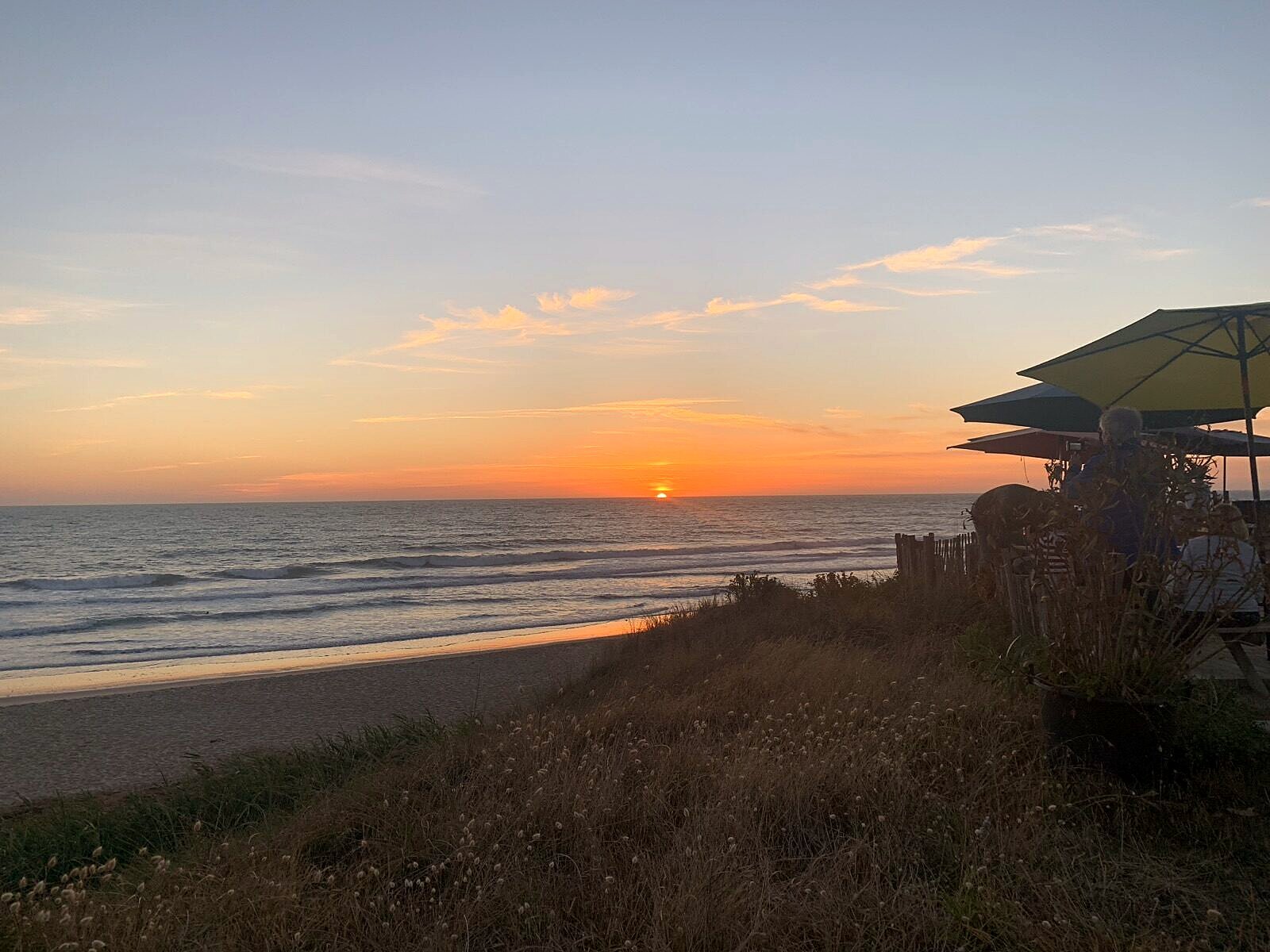
Beach — 1.5 km of Atlantic, three access points
The beach is the heart of Euronat. A continuous fine sandy beach along the Côte d'Argent, with clear Atlantic water and waves that range from calm to powerful depending on wind and tide. In total 1.5 km of naturist beach, running from south to north as one continuous stretch.
From the grounds, you can reach the beach via three access points:
- Plage Sud
- the southern access, the quietest of the three, the least visited. Lifeguarded in high season, with a beach volleyball court, toilets and showers.
- Plage Centrale
- the main access, with boardwalk through the protected dunes, lifeguard post in season, and surf school nearby. In summer there’s also a small kiosk for food and drinks here.
- Plage Nord
- the northern access and the dog beach. Dogs are allowed here even in high season — with clear ground rules to protect everyone (more in Practical matters).
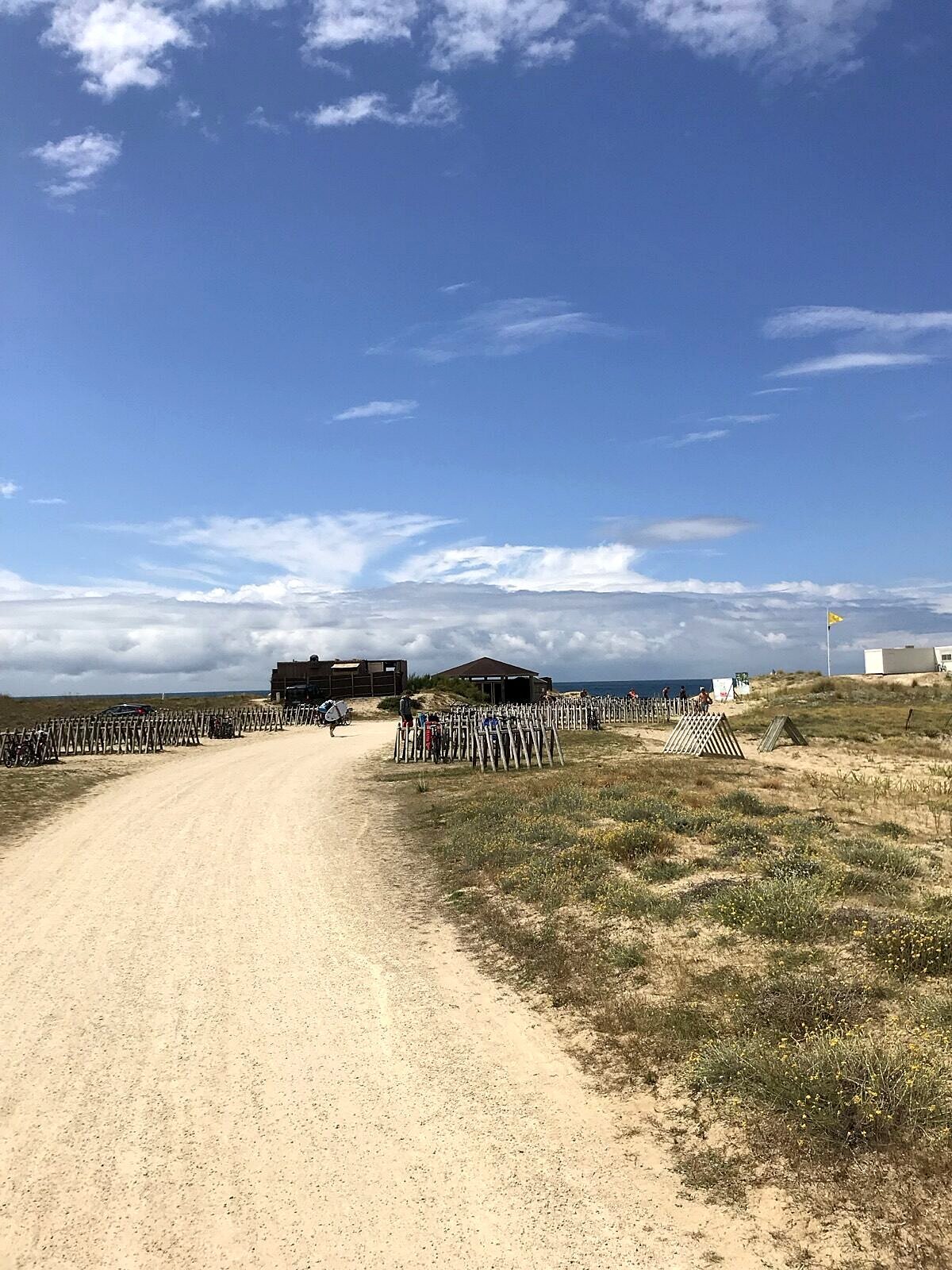
Pool — renovated in 2022
The pool is, alongside the beach, the second great meeting point. Several pools, all thoroughly modernised in 2022:
- Indoor pool 25 × 15 m for swimming laps, plus a smaller 5 × 15 m pool for the youngest. Comfortable water temperature all year round, with a solarium and loungers around it.
- Outdoor pool 20 × 12 m, heated, with a surrounding terrace. Open from mid-June to mid-September, and on some May holidays in good weather earlier.
- Lagoon with a lazy river, massage jets, and lounging islands in the water.
- Slide pool with two water slides — the actual fun pool for primary-school-age children.
- Paddling pool for the smallest ones, newly renovated.
In the entire pool area, naturism is compulsory — swimwear is not allowed. If that’s not your thing, you have the Atlantic beach right outside.
Centre — the village square with bakery, restaurants and shops
The Centre is Euronat’s village square. Here you’ll find everything you need day-to-day — and much that you appreciate for a relaxed holiday. More than twenty shops and restaurants are grouped around the central square:
Bakery with fresh croissants from early morning. Supermarket with fruit, vegetables, regional cheese, and a well-stocked wine section. Butcher and charcuterie counter with their own grilling recommendations. Fishmonger with whatever came in from Royan or Arcachon the day before. Plus bistros, an ice-cream parlour, bookshop, hairdresser, tobacconist, bike rental, cash machine. There are several restaurants — from the family-run place that has been at the Centre since the 80s, to the pizzeria with takeaway for a quick beach day.
In high summer, concerts, dance evenings and small markets are added. That makes the place lively without tipping over — Euronat isn’t for pure party-goers, but in high season there’s certainly something going on in the evenings.
Sport, movement, bicycle
Tennis, archery, pétanque (French boules with steel balls), volleyball, table tennis, morning yoga sessions, water gymnastics in the pool, riding at the stable in front of the entrance. In summer, plenty more activities are on offer. If you want to come by bike: the Médoc has an extensive network of cycle paths — the Vélodyssée long-distance route runs right past the grounds. Bicycles can be rented on site.
Thalasso — also open to day guests
The naturist thalasso centre is a feature that distinguishes Euronat from many other resorts: 1,600 m² of wellness with seawater pool at 31 °C, hammam, sauna, jacuzzi, massages and beauty treatments. It’s also open to day guests not staying on the grounds — the ideal half-day option when the Atlantic weather doesn’t play along.
Children
Three children’s clubs, by age: 3 to 6, 7 to 11 and 12 to 16 years. Craft workshops, sports tournaments, beach games, treasure hunts, discos for teens. The programme runs only in high season — get the current schedule at the info desk near the camp entrance. Staff speak French and English.
For many of our guests with children, this is the reason they come back again and again — the children find friends straight away, and the parents get hours of actual holiday.
The region around it
Montalivet — the next town, four kilometres away
Montalivet-les-Bains is right on your doorstep — four kilometres from Euronat, twenty minutes by bike, five by car. This is the place where everyday life happens when you don’t want to stay on the grounds. Bakeries, surf schools, an Aldi for the big shop, restaurants along the beach promenade.
The heart of it: the Montalivet market, one of the largest in France. Over 200 stalls, daily from 8:30 to 13:30 in high season (until 14:00 on weekends and bank holidays), and continuing in the market hall outside the season. You don’t just shop here — you spend a morning here.
And our personal recommendation: oysters are best eaten right here at the market. It’s properly busy, everyone stands close, no-one has a table reservation. You grab a dozen fresh oysters from a stall, a piece of baguette from the baker two stalls down, and a glass of white wine from the Médoc. Standing, between the market stalls, with the voices around you. You don’t need more than that.
Soulac-sur-Mer — the larger neighbour, ten kilometres away
Soulac-sur-Mer is the next larger town along the Atlantic coast, about ten kilometres north. 19th-century Belle Époque architecture, a historic market hall open daily 8 to 13 from April to September (plus evenings 18 to 20 in July and August), and the Basilica Notre-Dame-de-la-fin-des-Terres, a pilgrim site on the Camino, whose crypt was buried by drifting sand for centuries and excavated in the 19th century. If you need a Lidl for the big shop, you’ll find it in Soulac.
Phare de Cordouan — the king of lighthouses
On a sandbank in the Gironde estuary stands France’s oldest still-active lighthouse. Reachable by boat from Le Verdon-sur-Mer in about 30 minutes, from April to October. A real recommendation if the weather is right: 311 steps up, a panoramic view over the Atlantic and the estuary at the top, and a royal 16th-century chapel at the base. Booking in advance is recommended in summer.
Lac d'Hourtin — for the days you don’t want the sea
Sometimes you want to be near water, but not into the waves. In strong wind, high swell, or when the kids need flatter water for once. Then the Lac d'Hourtin is the right place — the largest freshwater lake in France, about 30 km south of Euronat. Two spots we can particularly recommend:
Plage de Piqueyrot — the lake for the little ones
Very shallow entry, fine sand, the water deepens only slowly. Small children can paddle for hours in the front. Anyone with little kids knows the value of that: you always have to watch, but here it’s much more relaxed than on a beach with waves. The beach is supervised in summer. Right at the beach there’s a small restaurant for snack and coffee — ideal for the break between two swimming rounds. Pedal boat rental nearby. Anyone with a dog can settle a little to the side — the area between the pedal-boat jetty and the main beach is tolerated.
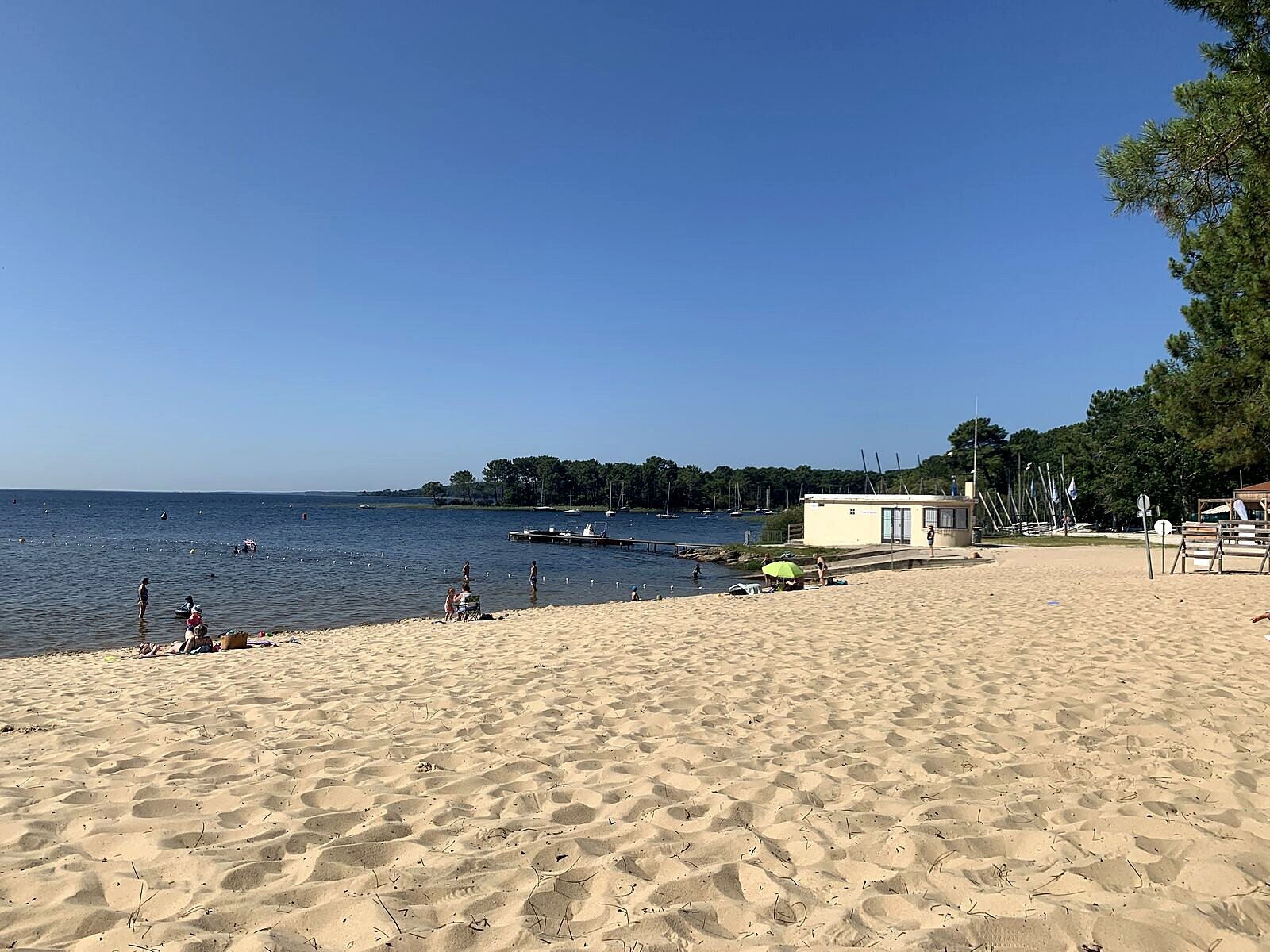
Beach Club Bombannes / Aquapark UCPA — the lake for the older ones
For older children, teenagers, and active adults. Right at the beach there’s a climbing park and an aquapark with water stations. The drive is a bit longer in summer because you have to go via Maubuisson — but that’s also an advantage: Maubuisson is good for shopping before or after the lake.
Dune du Pilat — Europe’s tallest sand dune
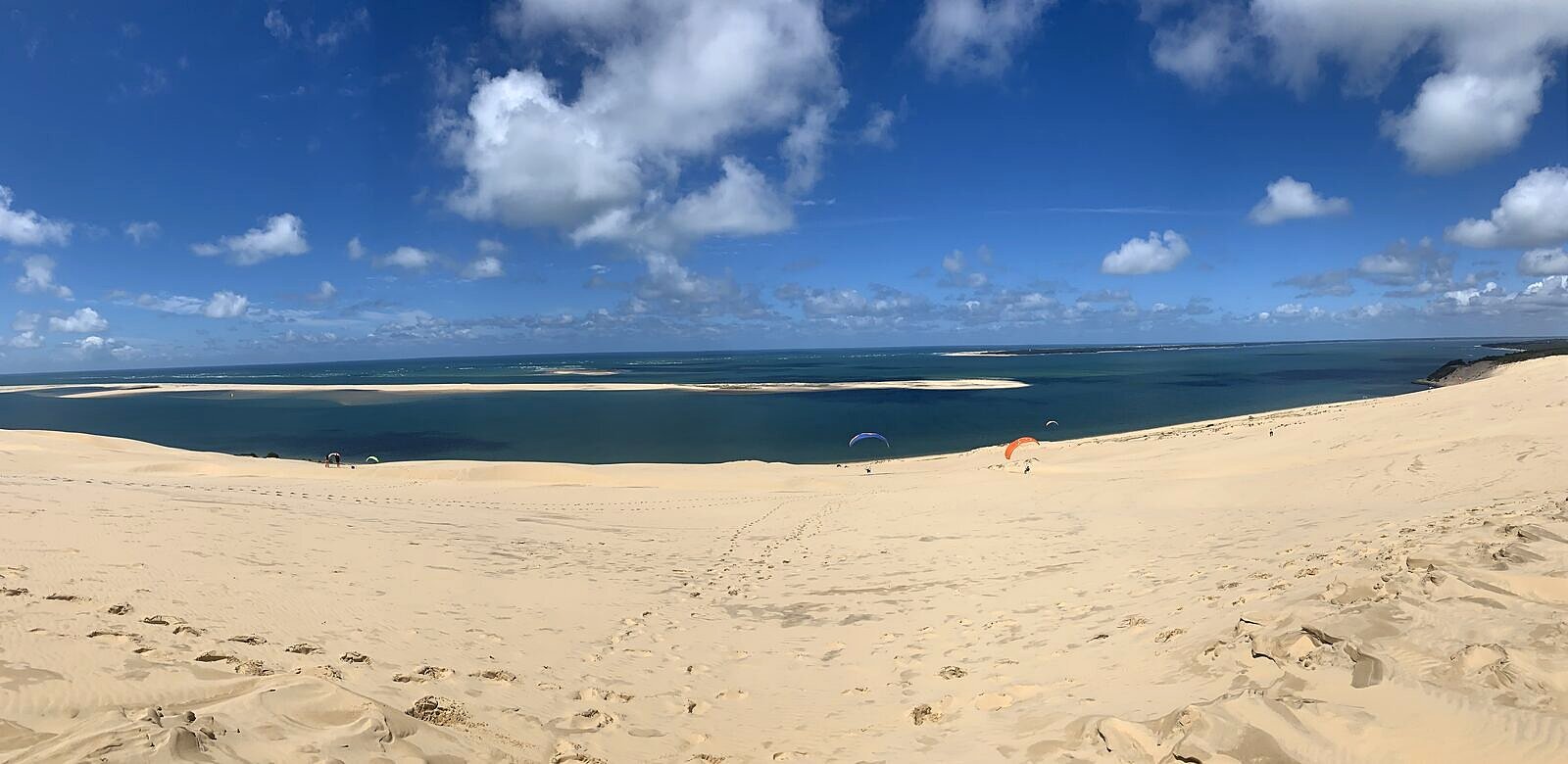
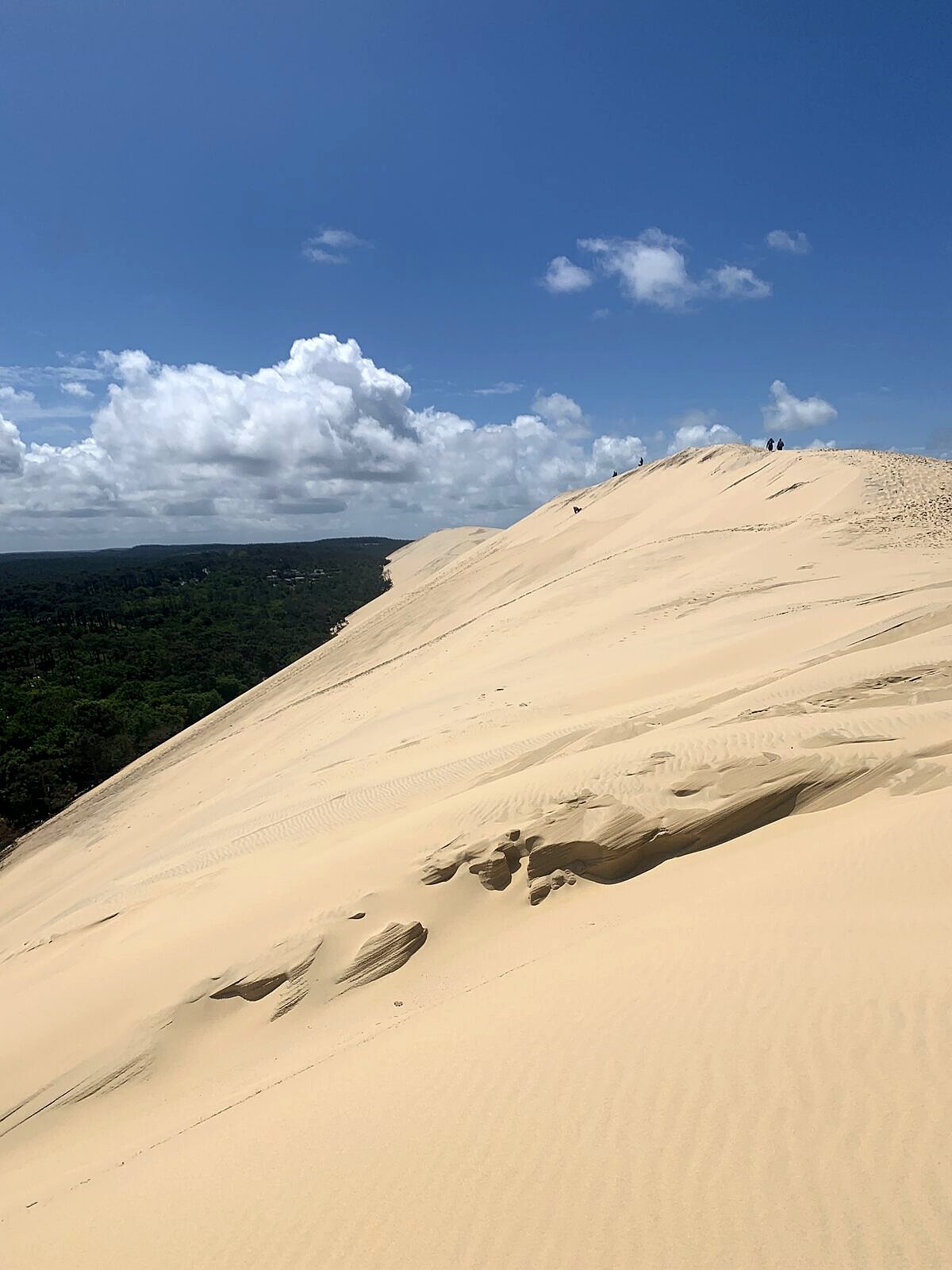
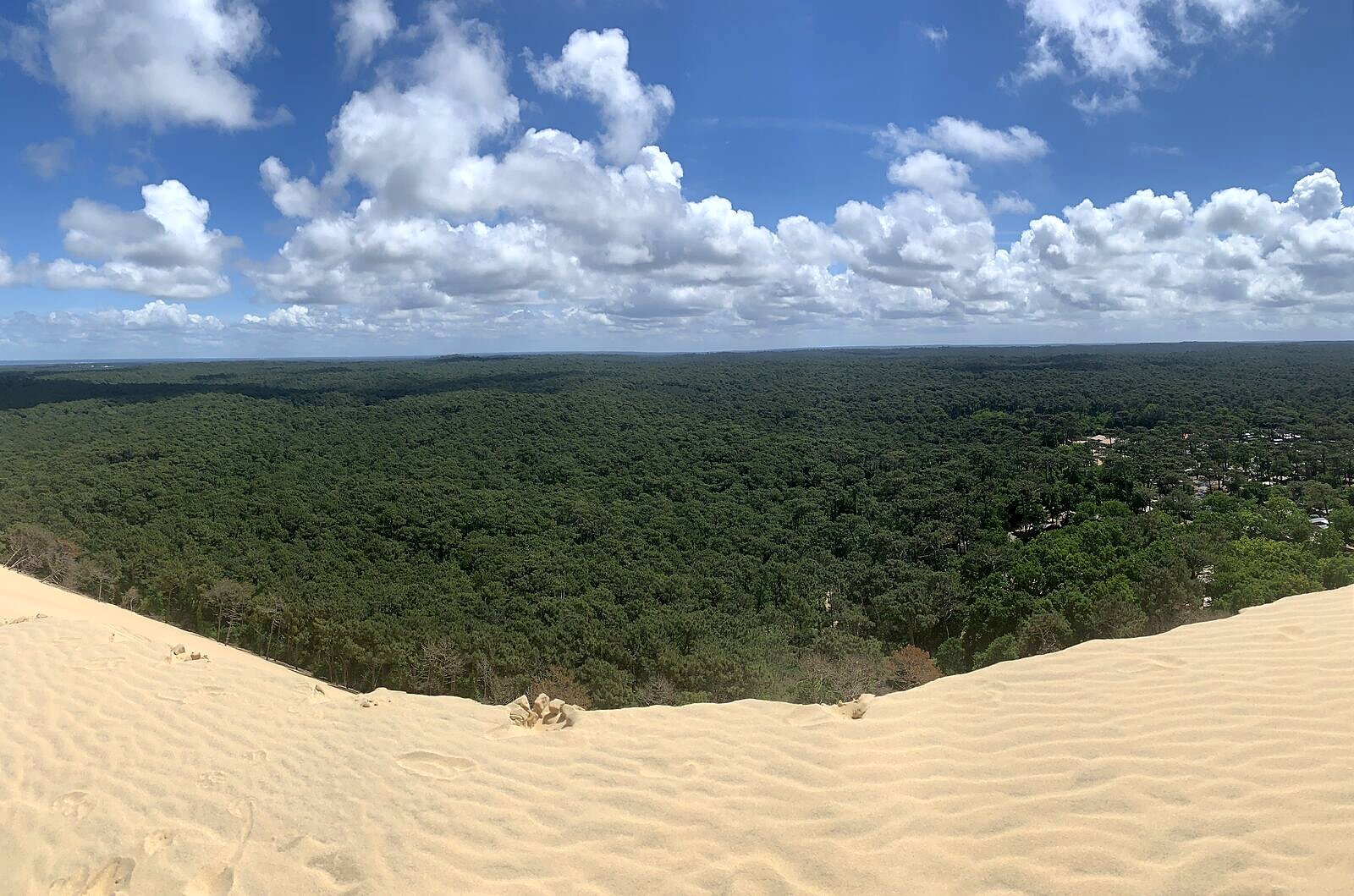
About 110 metres high, almost three kilometres long, framed by pine forest on one side and the Atlantic on the other. The Dune du Pilat is Europe’s tallest sand dune and lies at the entrance to the Bassin d'Arcachon, a good two-hour drive south of Euronat. A day trip, not a half-day destination — but one that stays with you: anyone standing on the ridge and looking west to the open Atlantic, east to the pine forests to the horizon, understands why this place appears in every guidebook.
Médoc wineries and Bordeaux
Euronat lies at the northern end of the Médoc — that strip of land between the Atlantic and the Gironde estuary, world-famous for its wines. Margaux, Pauillac, Saint-Estèphe are just under an hour south, and the tourism offices in Lesparre and Pauillac arrange tours in every price range. Bordeaux itself is a good hour and a half by car — UNESCO World Heritage, the “Cité du Vin” wine museum, a worthwhile day trip when the Atlantic weather takes a break.
Where we like to eat
When you don’t want to stand at the grill yourself or eat at the Euronat restaurant, these are our two recommendations in the area:
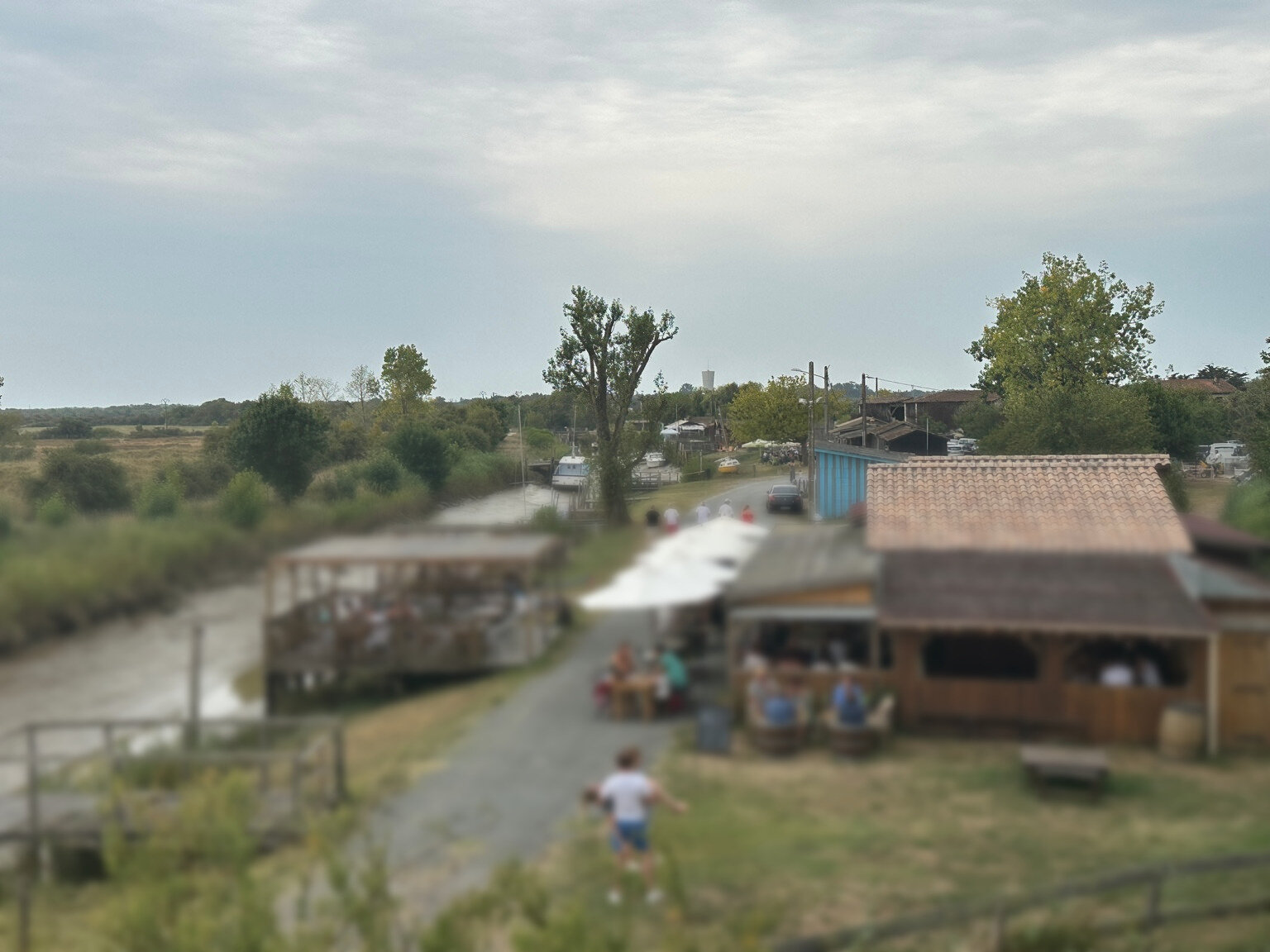
Le Kayak Café (Saint-Vivien-de-Médoc) — a real French guinguette right at the small harbour on the Chenal du Gua. Simple, plain, with a compact menu of local produce: oysters, prawns, the usual from the Gironde. Exactly what you imagine as “typical French” — and what you actually get. Next door you can rent kayaks and paddle on the Chenal — best in the shoulder seasons, since the channel often has very little water in midsummer.
Address: 16 bis Route du Port, 33590 Saint-Vivien-de-Médoc
Arroma (Montalivet-les-Bains) — a step up in price, but in return, modern bistronomic cooking by chef Arnaud Galis. We were impressed — the dessert in particular was really good. Open April to October, with garden and terrace. If you want a nice dinner in Monta: this is the place.
Address: 31 avenue Chambrelant, 33930 Montalivet-les-Bains
Weekly market tip: Saint-Vivien-de-Médoc
Saint-Vivien-de-Médoc is a genuine recommendation. Every Wednesday morning from 8 to 13, a market opens on the Place de l'Église that has kept its character unchanged for decades: vegetables from the grower a few kilometres away, cheese from the farm, sausage from the Médoc, fresh fish from the estuary, plus fabrics, jewellery, soaps from the local craftspeople. In high summer, a Sunday-evening night market is added around the church. Anyone wanting to see the Médoc away from the tourist routes shops here on Wednesdays — and ends up staying twice as long as planned.
Practical matters
Travelling by car
From Germany you’ll travel by car, and realistically you should plan a day and a half — at least if you want to arrive relaxed. A stopover in the middle (around Reims or Tours) makes the journey considerably more pleasant, especially with children or a dog. The route is well developed, mostly motorway, but long. Concrete distances are best checked directly in your route planner — they vary between 1,100 and 1,600 km depending on your starting point in Germany.
Tolls in France will apply — realistically count 70–80 euros each way. Diesel and petrol are similar to Germany.
Recommendation from the Ruhr area: the southern route
If you’re coming from the Ruhr area or the Rhineland, the route planner will offer you the most direct way via Belgium and the Paris ring road. During the day, in high season, or on weekends, this is rarely the fastest option. We recommend instead the southern route via Luxembourg, Metz and Reims: Aachen → A4 → Liège → Luxembourg → Metz → A4/A26 Reims → A10 Bordeaux.
The route is about 60 km longer but usually faster in practice. You avoid the dense traffic in the Paris area, get through reliably without stop-and-go, and pass through calmer regions with better rest options and fewer truck convoys. In the low season or at night, the direct route via Paris is usually the faster one.
The Gironde ferry Royan ↔ Le Verdon
If you’re coming from Paris or the north, you can save a good stretch of driving by crossing the Gironde by ferry: Royan ↔ Le Verdon-sur-Mer. From Le Verdon it’s another 25 km to Euronat. Instead of going around the estuary in a wide loop south via Bordeaux, you cross directly in 20–30 minutes — saving over 100 km of detour.
The ferry is operated by the Département de la Gironde, with two ships. In summer at least 18 crossings per day, in winter about 8.
Two tips from experience:
- Saturdays at peak time the ferry can get full. The first crossing in the morning is usually still relaxed — later crossings often mean waiting.
- Sundays from midday are the considerably better choice if you want to avoid waiting times.
Current timetable and online booking: gironde.fr — Ligne des bacs Le Verdon-sur-Mer / Royan
By rail and air
Rail: TGV to Bordeaux Saint-Jean, then regional train to Lesparre-Médoc. From Lesparre, a direct bus to Euronat runs in July and August — that’s a real option for rail travellers without a car. Outside the summer months, the route goes via Soulac-sur-Mer and onwards by taxi. If you’re considering this, it’s best to confirm connections and times directly with Euronat reception in advance.
For our houses we still recommend a rental car on site — the region is far more relaxing to explore by car, particularly because of the markets and day trips to Bordeaux or the Dune du Pilat.
By air: Bordeaux-Mérignac is the nearest airport, about 100 km away. Direct connections from most major European cities. From there it’s around 1.5 hours by rental car to Euronat.
Seasons and weather
High season is mid-July to end of August — school holidays, full beaches, lively Centre, all restaurants open, children’s clubs running. If you want liveliness, come now.
Low season May/June and September are, in our view, the most beautiful weeks on the Atlantic: quiet, mild, the water still warm in September, the light softer. Less bustle, more atmosphere.
Weather: Atlantic climate — milder than the Mediterranean, more wind, more frequent passing showers. Water temperature 18–22 °C in summer, often warmest in September. The sun can be strong here, the wind often makes that less noticeable — the risk of sunburn is considerably higher than it feels.
Language
During the holiday season many Germans are here, sometimes more than French. Getting by in German on the grounds is often no problem at all.
At the Euronat reception, French, English and German are spoken. In the surrounding area — in Montalivet, Soulac, at the markets and restaurants — English is more readily accepted than it was ten years ago, and generally understood. A few French words open most doors, though. “Bonjour” when you enter, “merci, au revoir” when you leave, “une baguette, s'il vous plaît” at the baker — that’s courtesy expected in France, and it’s returned with warmth.
With a dog at Euronat — a privilege that comes with responsibility
Euronat has an official dog beach: Plage Nord, the northern beach access. Dogs are allowed there even in high season — they can run free, go into the water, dig in the sand. Even in the middle of August. That’s anything but a given: at most French Atlantic beaches, dogs are entirely banned from June to September, or tolerated only in early morning and evening hours.
Precisely because of that, this dog beach is a privilege — and we are all responsible for keeping it that way.
The northern beach does not belong to the dogs. It is a shared beach, on which dogs are allowed as long as the coexistence works. In plain terms:
- Never leave a dog unsupervised. If you nap on the beach or go into the water, you don’t let the dog roam alone.
- Be considerate of other beachgoers. Not everyone likes dogs, some are afraid, many children don’t know how to behave around them. Keeping your distance is the default, not the exception.
- Insecure or poorly trained dogs belong on a leash. Even if your own dog “just wants to play” — the other guest or other dog does not know that. If you’re not 100 % sure, you leash up.
- Pick up after your dog. Sounds obvious, sadly isn’t everywhere. Bring a bag, use the bag, dispose of the bag.
- In case of conflict, step back, don’t argue. If someone feels disturbed, distance and de-escalation are the right response — not “but this is the dog beach”.
Anyone who follows that finds a freedom here that you simply cannot find elsewhere on the coast in high season. Anyone who doesn’t puts that opportunity at risk for everyone else. The beach itself is a continuous sandy beach — anyone wanting to be without a dog goes to the main beach or the southern access.
Our houses there
If you’ve read this far, you have a pretty clear idea of what Euronat is — and whether it suits you. All of this is first-hand experience, gathered by us on site over the years. If the answer is yes, the second question follows: where to stay?
On the grounds you’ll find every variant — from a pitch for your own tent to a Euronat-owned villa. And there’s us: three holiday homes in private rental, looked after by us as the private owners ourselves — Egypte 9 West, Egypte 9 Ost and Egypte 7 Ost. Each house has its own terrace, its own garden in the pine forest — and its own character.
All three houses lie in the Afrique village — close to the southern beach. The distance to the beach and to the Centre is roughly the same, you’re central to both.
Book direct — more value, more proximity
Private rental at Euronat means: if you rent directly from us, instead of going through a booking platform, you benefit from what we save in the process. Three concrete benefits:
- More flows back into the houses. What doesn’t go to commissions, we invest year after year back into the houses — new mattresses, fresh paint, a better grill, the next update in the garden. Anyone who comes more than once sees the difference.
- Direct line. From the first enquiry to the key handover, you speak with us personally — not with a call centre that has to look up your name. Questions get answered directly, often the same day.
- Direct arrangements. Special requests or small adjustments are sorted out the short way, between us.
If you prefer a real house with its own outdoor space over a mobile home or a tent, you’re in the right place with us. More about private rental in Euronat →
Interested in one of our three houses?
Egypte 9 West, Egypte 9 Ost and Egypte 7 Ost — at Euronat, personally hosted.
Frequently asked questions
Do I have to be naked everywhere at Euronat?
No. Clothes-free is the standard on the grounds, but it isn’t mandatory. On the beach, in front of your own cabin, on the pine path — nudity is normal, no-one stares. If you’d rather keep trousers and a t-shirt on, you can. One single exception: the pool. There, naturism is compulsory and swimwear isn’t allowed. The reasons are hygiene and tradition.
Is Euronat suitable for families with children?
Very much yes. Euronat is a French family resort, designed exactly that way. Children’s clubs from age three (in high season), a renovated pool with paddling pool and slides, a protected beach with lifeguards in season, a safe site without through traffic. Many of our guests have been coming for generations — the children who were in the clubs as teenagers now come back with their own kids.
Can I just turn up as a beginner?
Yes. You don’t need to bring anything except a towel, sunscreen, and openness. At reception, you’ll be helped kindly, and the staff speak French, English and German. The first half-day is usually the hardest — after that, your shoulders come down, and you wonder why you put it off for so long. If you’re still hesitating: arriving outside high season is more relaxed.
How do I get there best from Germany?
By car is the most practical — distance depending on starting point between 1,100 and 1,600 km, driving time 13 to 17 hours. A stopover in the middle (around Reims or Tours) makes the journey considerably more pleasant. If you’re coming from the Ruhr area, it’s better in high season to go via Luxembourg, Metz and Reims than via Brussels and Paris — the route is 60 km longer but usually faster in practice. If you’re coming from the north, the Gironde ferry Royan ↔ Le Verdon saves over 100 km of detour. Flying to Bordeaux-Mérignac is the fast option, but then you’ll need a rental car on site.
When is the best time to travel?
In our view: May/June and September. Mild weather, warm water (often warmest in September), quieter beaches, softer light. July and August are often the only option for families with school-age children — then everything is open, all the entertainment runs, the atmosphere is lively, but also considerably more crowded.
What’s the atmosphere like in the low season?
Honestly: our favourite time. Anyone coming in September has the beach almost to themselves, the Centre is still open (though not all the shops), the water is warm from the long summer, and the restaurants are more relaxed. The mood tips from high-season bustle into something quieter, almost personal — you start seeing faces again, instead of just crowds. Anyone who has been here in the low season rarely comes back in August.
Can I bring my dog?
Yes. Euronat has an official dog beach at the northern access (Plage Nord), where dogs are allowed even in high season — a real rarity on the French Atlantic coast. Important: this is not a beach that “belongs” to the dogs, but one where everyone has to be considerate of each other — supervision, leash when in doubt, distance from other guests. Details and ground rules in the section Practical matters above.
Am I allowed to take photos on the grounds?
On your own property and for your own memory photos: yes, of course. On the beach and at the pool: no — photography is taboo there, and the smartphone stays in the pocket too.
In the Centre it’s more nuanced: a group photo at your own restaurant table, a picture of the kids eating an ice cream — that’s fine, as long as you make sure no-one else is in the frame. Photographing the place as a whole, or concerts and events, is off-limits. The principle is simple: no-one must end up in a photo unintentionally. Anyone keeping that in mind won’t go wrong.
More information
This page is our personal insider guide. For the official information on the resort — current opening times, the entertainment programme, first-hand photos of the site, day-ticket bookings or the thalasso centre — you’ll find everything directly on the official site:
Official website with current information, events and entertainment programme.